Blog Moving!!

IMPORTANT: This Blog Is Moving To My Website HERE and Updated with new Items. I will keep this active but it will not have any new content on it. Thank you for your support.

Labels

1860 (1) 1877 (1) 5.1 (3) 664 (1) 7.1 (1) adr (1) ambience (6) amp (1) amplification (2) amplitude (5) au clair de la lune (1) audio (20) balanced (3) batteries (1) battery (1) bit depth (5) cables (3) carbon microphone (2) compression (1) Condenser Microphones (3) critical angle (1) cycles per second (1) data rate (5) dB (1) dBa (1) dead spot (1) Decibels (1) definition (23) diffraction (1) Digital (1) directory (6) dither (1) documentary (3) Dolby (2) Dolby Digital (2) DTS (2) dubbing (2) dynamic microphone (3) dynamic range (1) edison (1) electromagnetism (1) equipment (3) equipment demo (1) ew 100 (1) explained (43) feedback (1) festivals (1) film crew pro (1) Film history (4) film jobs (2) Film Sound (42) film work (6) frequency (6) glossary (1) Heinrich Rudolf Hertz (1) help (1) Hertz (5) history (2) home cinema (1) How does it work? (28) hz (1) information (2) information on sound (4) Introduction (10) key features (1) law (1) laws (8) levels (1) looping (2) lossless (1) lossy (1) mAh (1) mandy (1) matt price (1) metadata (1) Meters (1) Mic Specs (1) microphone (7) ohm (1) paid film work (2) parabolic reflectors (1) pcm (1) phase (1) phasing (1) phonautograph (1) phonograph (1) physicist (1) PPM (1) Preproduction basics (2) quantization error (1) question and answers (1) questions and answers (26) radio microphone (2) reference (3) refraction (3) resource (12) reverb (7) review (1) room tone (6) sampling theorem (2) senhiesser (3) sensitivity (1) shoeps (1) something to watch (7) sound (3) sound basics (2) sound devices (1) sound equipment (16) sound news (1) sound pressure level (3) sound recording (25) sound wave (4) space (1) speaker systems (1) speed of sound (4) SPL (1) SUPER CMIT (1) surround (1) talent circle (1) technical (16) theory (16) transducer (1) unbalanced (1) unit of measurement (1) VU (1) walter murch (1) wave agent (1) websites (1) wild sound (5) wilhelm scream (1) worldizing (1) XLR (2)
Showing posts with label theory. Show all posts

Monday, 27 February 2012

Oldest Known Recording Unearthed From 1860

Previously the oldest recorded sound was thought to be Edison's phonograph recording of a children's nursery 

rhyme "Mary had a little lamb.." in 1877. So what did they use before the phonograph?

The "phonautograph", is used by etching paper covered in soot. US scientists used a virtual stylus to read the lines. The recording was found by audio historian David Giovannoni who said to the Associated Press "When I first heard the recording as you hear it ... it was magical, so ethereal,"

"The fact is it's recorded in smoke. The voice is coming out from behind this screen of aural smoke."

The phonautograph was made by a Parisian inventor, Edouard-Leon Scott de Martinville. The new recording will be presented on 28 March at a conference of the Association for Recorded Sound Collections at Stanford University in California.


The video below is the 10 second clip of "Au Clair de la Lune".


This is the video of Edison's recording of "Mary had a little Lamb"


Thanks

Wednesday, 22 February 2012

Heinrich Rudolf Hertz - 155th Birthday

Well would be but sadly died at the age of 36! But didn't take him long to see what everyone else couldn't.

Im sure you have guess the young German electronic engineer and physicist who clarified and expanded the electromagnetic theory of light introduced by James Maxwell publishing his theory in 1865. Maxwell was also phenomenal is creating a theory from seemingly unrelated experiments and studies of electricity, magnetism and optics and combined them. He was also known for the first durable colour photograph earlier in 1861 and even did foundation work on rigidity for bridges, and is considered one of the greatest physicists of all time.

Back to our friend Heinrich Rudolf Hertz. He was the first to prove with immense certainty the presents of electromagnetic waves by designing and engineering instruments to transmit and receive radio pulses using procedures to discredit other sources of wireless phenomenon. As such his name was given to the unit of frequency known as, you guessed it Hertz (Hz)


Just So I Don't Breech Copyright :)
See a better image of him from Wikipedia


Wednesday, 19 October 2011

5 More Pre Production Location Sound Recording Basics (Part 2)

As I am a generious guy I thought I would bash out part 2 of pre production basics (meaning essencials and at the very least)
read part one of 5 pre production basics part one

6. Double system 99% of the time
Unless this is a run and gun documentry or live broadcast location news then you probably have the freedom to easily slate and thus easily sync sound from a seperate sound recording device. The double system gets its name because you have one system for visuals and one for sound (according to my understanding)
This has many advantages such as easier capture for wildtracks, better quality recording due to higher quality specific sound recording electronics and wiring, more flexability to be out of the cameras way and less interference from longer cables, balanced or otherwise.

7. Order of priority
Equipment wise, your only as good as your weakest link and many other metephors a side, the equipment is of this importance as it works in a chain, obviously if anything in this chain is terrible then bring that up to the level of the others.
Your first link is the microphone/s its self, this will determine the amount of electronic current that needs amplifaction, the quality of the frequency response and how much other sound outside the polar pattern will be discrete (blocked).
Next is the mixer of some sort (please not just your camera!) Where it will be able to amplify the microphones electric voltage differences to acoustic energy and the better the pre amps and limiters the better the signal to noise ratio and the less your likley to peak and distort any unwanted, un expexted loud sounds.
Finally the recording device which is last because thankfully you have a good mixer doing most the leg work, dont you :-), this allows the freedome of the double system mentioned earlier.
Also dont forget to get balanced cables (refer to glossary) and the fewer cable to cable connections the lesser the chance of interference and noise being amplified with any recording. along with a good support for your microphone on a boom pole so you limit handling noise.

8. Information is only potencial power
Grab as much information on storyboards and floor plans and sizes of rooms and whats near by the location referring to the script. This could save you loads of time on the day in regards to descision making and mike placement, we both know its never exactly like the plan but better to have a guide!

9. Be ahead of the game
Referring to the edit, before hand you can draw up lists for wildtracks and sound effects which could be benificial to the troops in the edit. On another small note: REMEMBER ROOM TONE/ATMOSPHERE RECORDINGS FOR EVERY LOCATION. It's kind of useful, do at least 15 clean! seconds

Finally Number 10. Fail to plan, plan to fail
Not all these elements might be relevant to the situation but it does save you time in the long run and sets a good solid foundation for the edit. After we are part of a bigger creative team to achieve a great end result and just by reading articles like this you know it's more than a job but a lifestyle especially in independant low budget projects. :-) happy days.

Thanks.and comment or share below

Matt Price

Friday, 30 September 2011

PCM - Pulse Code Modulation

PCM or pulse-code modulation is a method to digitally represent sampled analog signals. This is the standard system for digital audio in computers and various DVD, Blu-ray formats and in digital telephone systems.


Each sample is quantized to the nearest value within a range of digital steps. The two properties of PCM are the sample rate and the bit depth, this determines the number of digital values in the range.


See article on Bit depth and Sample Rate for more info.


Cheers,


Matt Price

Thursday, 18 August 2011

5.1 Surround Sound, Dolby or DTS?

This is section explaining what Dolby Digital 5.1 and DTS 5.1 are, along with a bit about why people think one is better than the other etc...

What is 5.1?
Refers to this speaker set up: (left front, left rear, right front, right rear, and center), plus a subwoofer channel (the .1 in 5.1)

What is Dolby Digital Surround Sound?
This is the most common format for surround sound on media such as movies. Its a discrete channel surround sound format because the output has been controlled to come from a variety of speakers, allowing a car to sound like it is moving across the screen etc....

What is DTS?
DTS (Digital Theater Systems) is a digital surround-sound system first introduced in theaters in 1993. DVDs encoded with a DTS soundtrack require a DVD player and stereo receiver equipped with DTS-processing capability. This is partly due to the DTS demands for more data space on a DVD (often sacrificing bonus features), but many believe the audio quality to be superior to that of Dolby Digital 5.1-channel surround sound.

What do people think?
I don't happen to be 'the people' but reading up and around the issue DTS has a higher data rate and so that roughly translates into 'better' sound. Where as many Dolby fans argue that low compression but higher data rate provides 'better sound'....

Ill need another 10 years to provide a better description of 'better sound' but many blogs start with the underdog against the giant, like in all fairy tales...

I should be pointed out that both Dolby Digital and DTS Digital Surround encoding schemes now have even higher sampling rate of 48 kHz at 20-bits per sample, thus yielding an even wider dynamic range between sound level extremes of approximately 120dB.

They both have to be compressed in some form to fit on the disk so that is always going to be an issue, raw data over efficiency is hard to prove when sound is subjective.

"Compression and bit-rate are not the only differences when comparing Dolby vs. DTS formats. For example, the added rear surround channel in Dolby's extended surround format 'Dolby Digital EX', is matrixed over the two left and right surrounds, rather than discrete; instead the DTS counterpart uses a discrete channel. This also explains why DTS ES (Extended Surround) can provide a more precise location for the rear-effects soundstage than the Dolby EX format." - Source here

"Both Dolby Digital and DTS audio are capable of achieving similar end results in delivering surround sound, even though the lower compression/higher bit-rate of DTS Digital Surround should theoretically yields apparent benefits in sound quality.

At the same time, one cannot ignore the fact that these two formats make use of different coding schemes and syntax to perceptually compress audio.

This means that efficiency in terms of data utilization between these two formats is different. Therefore, a Dolby vs. DTS direct comparison based solely on these formats raw bit rates cannot be taken as a measure of sound-quality.

Thus, while it is objectively possible to compare the resultant sound quality for the same audio format encoded at different bit rates, and therefore, to determine whether the same format in a moviehouse application sounds better or worse than in a consumer implementation in home entertainment, it is not so straightforward when dealing with different formats.

Rather, the reality is that for identically sourced audio content, it would be much easier for the listener during a Dolby vs. DTS 'blind' listening test to notice a change in sound quality when changing the playback equipment say between different brands, than when changing from a Dolby Digital to the DTS surround audio track." - Source here


So it is down to choice really and if it you set up your theatre, home cinema etc... then you might notice one suiting your needs better, Sadly this is going to be a never ending debate but at least you can argue both ways forever with your friends.

Thanks

Matt Price

Sunday, 14 August 2011

Sampling theorem


The Nyquist–Shannon sampling theorem, after Harry Nyquist and Claude Shannon, is a fundamental result in the field of information theory, in particular telecommunications and signal processing. Sampling is the process of converting a signal(for example, a function of continuous time or space) into a numeric sequence (a function of discrete time or space).

Sampling theorem which in essence shows that a bandlimited analog signal can be reconstructed perfectly from an infinite sequence of samples if the sample rate exceeds 2B samples per second. B is the highest frequency in the original signal. If the signal contains components at exactly B hertz, then samples spaced 1/(2B) seconds do NOT completely determine the signal.

E.g. 20,000 Hertz into this forumla will not be reconstructed perfectly at anything less than 0.00003 seconds per sample. Recording at a sample rate of 48kHz is sampling at 0.00002 seconds per sample, hence for situations like recording dialogue where the highest frequency for normal conversation is below 20kHz (because we can't hear higher).

Possibly Useful Drawing of a 2hz sine wave


So in recording effects if you wanted to have flexibility to manipulate then you can record at 192kHz and then the spacing is 1 sample every 0.0000052083 of a second, this is useful for slowing down samples more effectively than less samples.

This is again like most perfect theories based on a perfect world and so is an approximate in our not so perfect world.

Hope this ended up making sense.

Thanks,

Matt Price

Ohm ohm ohm... amp?

Ohm's or Î© is the SI or system of international unit of electrical resistance and gets it's name from Georg Simon OhmOhm determined that there is a direct proportionality between the potential difference (voltage) applied across a conductor and the resultant electric current. This relationship is now known as Ohm's law.

So an Ohm is a unit of resistance between two points of a conductor when, for instance, a constant 1 volt difference is applied to each point and it produces 1 ampere.

Ampere  It is named after André-Marie Ampère (1775–1836), French mathematician and physicist, considered the father of electrodynamics. In practice, its name is often shortened to amp. An amp is a SI for basically a rate of flow in a wire. 

So an ohm is just a way of measuring how easily electricity flows along a certain path. Electrical resistance shares some conceptual parallels with the mechanical notion of friction.

Leave comments if still confused =]

Thanks,

Matt Price

Thursday, 28 July 2011

Refraction

This is the bending of waves when they enter a medium where their speed is different. This is less important than refraction of light as it affects image formation of images by lenses and eyes etc... 


If we use the example illustrated above shows that the first medium of air the light travels straight but when it hits the second medium of the glass it bends depending on which side hits the second medium first, it will bend left if the left side hits the second medium and slows down and refracts. 


Not only the direction changes but separation of the waves decreases as the frequency of the waves does not change by its source but the shower speed must shorten the wavelength.


This is also interesting in sound because if the air above the earth is warmer than the surface, sound will bend back downwards towards the surface by refraction. If the air above the earth is warmer than that at the surface, sound will be bent back downward toward the surface by refraction.


Refraction also amplifies sound sometimes over cool lakes in the morning. The water keeps the air cool near the water but as the sun comes up it heats the air higher up creating a thermal inversion. The speed of sound is faster in the warmer air and so bends some sound back towards you.


also see: Diffraction


Thanks,


Matt Price

Diffraction

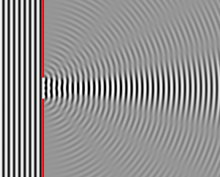
One of the interesting properties of sound waves is that they can diffract like the image below demonstrates.


The possibility of hearing around corners or barriers involves diffraction and reflection of sound. Diffraction is mostly associated with longer wave lengths as thus implies that you hear low frequencies than higher ones. This is also explained by the fact air absorbs higher frequencies better than lower ones. A lightning strike for instance has a high crackle with a longer low rumble.

Sound proofing rooms takes this into account and so the room has to be fully sealed because diffraction can disrupt a lot from the smallest gaps. This is a similar reason for loud speakers to be sealed so they maximise output. 

An interesting characteristic involving imaging. When a wavelength is longer than an obstacle, for instance a pillar means you can't see the obstacle. This is the same reason you cant see a virus under a light microscope because the virus is smaller than the waves of light. This is due to the bigger wavelength diffracting round the obstacle and reconstructing past it. 


See also: Refraction

Feel free to comment,


Thanks,

Matt Price

Reverberation Time

A reverberant sound in any closed space like a room or concert hall diminishes as the sound energy is absorbed by multiple interactions with the surfaces of the room. Though the speed it takes to diminish depends on the variable of the rooms surfaces, for instance a reflective  or "live" room will take longer than a very absorbent or "dead" room. The time for the sound to completely die away will depend how loud the sound is at the start and how well the observer hears. 


The standard reverberation time has be established as the time it takes for a sound source to diminish by 60 dB below its original level. This is established at 60dB from testing in auditoriums where the loudest crescendo in an orchestra is 100dB and typical background noise for a music-making area being around 40dB. 60dB is also roughly the dynamic range for orchestral music.


In terms of time it depends on the rooms use. In a classroom you want the room to have low reverberation time to keep articulation clear and reduce build up from people talking. In an auditorium you probably want a bit more so you can really feel the music. As a general rule you wont get long reverberation time in a small room because of how fast the energy is bouncing off the surfaces and being absorbed a bit each time.


Reverberation time is just one part in creating pleasing environments for sound, you also need to consider the absorption in terms of frequencies.


Thanks,


Matt Price

Inverse Square Law Of Sound

Hello All,


This blog is on the inverse square law of sound which is a very important law that not many really know about (we will get onto that later) Sound waves propagate spherically and so distributed over and ever increasing surface of diameter at the front surface of the wave. The inverse square law tells us that every doubling of the distance from the sound source in a free field situation the sound pressure level will diminish by 6 decibels.


Why many may not know this law is that it is hard to get a free field situation such as an explosion of a bomb in mid air. Though not perfect for real life situations it is a very important guide to sound sources and how they diminish over distance. 


As an example lets say a person shouts at 70dB at 3 feet away from you in a room, at 6 feet it will be 62dB and at 12 feet 56dB and at 24 feet 50dB. This example on works as a guide not taking into account reflections from any walls of a room and any other sound in the room at the time of shouting.


Thanks,


Matt Price

World-a-lies-ing

Instead of you having to read everything like back in the 1800's i thought i would indulge all your senses to a quick video interview with Walter Murch. I will write up another blog that will go into more detail about different types of reflections of sound off surfaces and all of that jazz later today as i have just a few more days till im back on several shoots. Enjoy!
Manipulating sound until it seemed to be something that existed in real space. This refers to playing back existing recordings through a speaker or speakers in real-world acoustic situations, and recording that playback with microphones so that the new recording takes on the acoustic characteristics of the place it was "re-recorded." [via filmsound.org]

Thanks,

Matt Price

The camera that changed the world

Film Link: Camera That Changed the World
Only available for the next 5 days.


This is a quick post about a documentary availible on the BBC iPlayer that shows the evolution of the portable camera and how important it was to the documentary genre. At around the 45 minuite mark there is a short section on the importance of the Nagra and sync sound. So if you can spare an hour over the next 5 days it's worth a watch.


Thanks,


Matt Price

Tuesday, 26 July 2011

Microphone Polar Patterns...

This outlines the types of polar patterns. Polar patterns are the field of focus that the microphone will pick up due to the position of the diaphragm and other factors.


0 degrees is straight infront of the microphone, 180 degrees is directly behind the microphone


Omni Directional
This encompasses a field of all directions, or nondirectional. In theory it should be a perfect sphere but because the microphone its self is not infinitely small it gets in its own way, just like if it was on a persons body. So the smaller the body the better the polar pattern. The wave length of 10Khz is 3.4cm so small microphones are effective at even high frequencies.


Cardiod

This is the most common unidirectional microphone. There is a dip at the back due to the microphone casing and the direction of the diaphragm. A Sub cardiod is similar to the omnidirectional polar pattern but flatter. and Super and Hyper cardiod have tighter patterns compared to the basic cardiod pattern, but they add more sensitivity to the cardiod because of there higher sensitivity.

Shotgun
These are the highest directional microphones. They have small fields of sensitivity to the left, right and rear. This is still significantly smaller than other directional microphones. This is the most common on film sets for booming over subjects.


See Also: Condenser Microphones, Dynamic Microphones and Carbon Microphones.


images are free to reuse via wikipedia

Thanks,

- Matt Price

Q+A: Bit Depth and Bit Rate Explained....

This is a quick guide to bit depth, sample rate and recording volume.


Bit Depth
Bit depth describes the number of bits of information recorded for each sample. This directly corresponds to the resolution of each sample.


a "bit' is an abbreviation for a single binary digit, represented by a 0 or 1. A word in audio is a binary number with more than one digit. A 16-bit binary number for example could be 0111011010110010. The number of bits per word is simply how many digits there are in the corresponding number. Common bit depths are 8, 16 and 24 so the higher the quality is the higher the number. 


The bit depth in recording refers to how many steps the amplitude can be broken down into to be represented digitally. 
16 Bit = 65,536 Steps 
24 Bit = 16,777,216 Steps
You can clearly see that 24 Bit would be considered higher quality as it is able to plot smoother more accurate lines of amplitude.


The Bit Rate is how many of these bits are being transmitted or received per second. This is used for streaming purposes on videos as well. For playback, using the example of a standard CD with a datarate of 48kHz/24, meaning the sample rate was 48,000 times per second with bit depth of 24. The amount of audio data per second is worked out like this: 


48000 x 24 x 2 (for stereo recordings) = 2,304,000 bit/s or 2.3 Mbit/s.


The size of an audio file size can be calculated with a similar equation.The equation below is with the example of recording at 48khz at 24 bit depth, that plays out in stereo (so 2 channels, recording 5 you would x5) for 60 minutes which is 3,600 seconds and divide by 8, you then get this:


48000 x 24 x 2 x 3600 / 8 = 1036,800,000 Bytes or 1.036GB


So bit depth is your resolution for the information for each sample but many would argue there is no massive difference for recording dialogue between 16bit or 24bit but if you have the space why not.


See also: Sample Rate Explained


Thanks,


- Matt Price


Monday, 25 July 2011

Q+A: Basic Sound Questions...

This is going back to basics with what is sound anyway?...


What is sound and how is it created?
Sound is a vibration and/or a wave of air molecules caused by motion of an object. This wave is a compression wave where the molecules are bunched up like a wave in the sea, A sound wave is created when a series of these pressure changes/waves move through the air. This wave or waves speed depends on the temperature, e.g. at 15 degrees Celsius the speed is 340.276 m/s but at 25C the speed is 346.13 m/s. (Calculator here).


Through solids the wave will bounce back or echo/reverberate and the energy can change from acoustical to electrical energy which is how microphones and telephones are able to work.


What is frequency?
When drawing a sound wave, like with any wave there is a peak and a valley which vary in distance from each other. Sound sources vibrate at different rates or frequencies as they move through the air. We measure frequency in cycles per second or Hertz. This is named after Heinrich Rudolf Hertz (February 22, 1857 – January 1, 1894) who was a German physicist who was the first to satisfactorily demonstrate the existence of electromagnetic waves by building an apparatus to produce and detect VHF or UHF radio waves.
The faster an object vibrates the higher the frequency and thus higher the pitch of the sound. a common example is a tuning fork for A above middle C will vibrate at 440 times per second and so has a frequency of 440 Hertz.


What is amplitude? 
We already understand by now that sound is made by pushing air molecules together in varying degrees of strength, this is amplitude. for example if something is struck really hard the wave will carry some of that energy through the air and it will sound louder than if it is struck gently. Sound waves with the same frequency can have different amplitudes.


Feel free to add any comments if i haven't covered anything in enough detail.


Thanks,


- Matt Price