Blog Moving!!

IMPORTANT: This Blog Is Moving To My Website HERE and Updated with new Items. I will keep this active but it will not have any new content on it. Thank you for your support.

Labels

1860 (1) 1877 (1) 5.1 (3) 664 (1) 7.1 (1) adr (1) ambience (6) amp (1) amplification (2) amplitude (5) au clair de la lune (1) audio (20) balanced (3) batteries (1) battery (1) bit depth (5) cables (3) carbon microphone (2) compression (1) Condenser Microphones (3) critical angle (1) cycles per second (1) data rate (5) dB (1) dBa (1) dead spot (1) Decibels (1) definition (23) diffraction (1) Digital (1) directory (6) dither (1) documentary (3) Dolby (2) Dolby Digital (2) DTS (2) dubbing (2) dynamic microphone (3) dynamic range (1) edison (1) electromagnetism (1) equipment (3) equipment demo (1) ew 100 (1) explained (43) feedback (1) festivals (1) film crew pro (1) Film history (4) film jobs (2) Film Sound (42) film work (6) frequency (6) glossary (1) Heinrich Rudolf Hertz (1) help (1) Hertz (5) history (2) home cinema (1) How does it work? (28) hz (1) information (2) information on sound (4) Introduction (10) key features (1) law (1) laws (8) levels (1) looping (2) lossless (1) lossy (1) mAh (1) mandy (1) matt price (1) metadata (1) Meters (1) Mic Specs (1) microphone (7) ohm (1) paid film work (2) parabolic reflectors (1) pcm (1) phase (1) phasing (1) phonautograph (1) phonograph (1) physicist (1) PPM (1) Preproduction basics (2) quantization error (1) question and answers (1) questions and answers (26) radio microphone (2) reference (3) refraction (3) resource (12) reverb (7) review (1) room tone (6) sampling theorem (2) senhiesser (3) sensitivity (1) shoeps (1) something to watch (7) sound (3) sound basics (2) sound devices (1) sound equipment (16) sound news (1) sound pressure level (3) sound recording (25) sound wave (4) space (1) speaker systems (1) speed of sound (4) SPL (1) SUPER CMIT (1) surround (1) talent circle (1) technical (16) theory (16) transducer (1) unbalanced (1) unit of measurement (1) VU (1) walter murch (1) wave agent (1) websites (1) wild sound (5) wilhelm scream (1) worldizing (1) XLR (2)
Showing posts with label room tone. Show all posts

Wednesday, 19 October 2011

5 Basics For Location Sound Pre Production Part 1

Hello all,
It has been a while so I shall treat you to this blog covering 5 very basic things to cover in PREPRODUCTION for your location shoot.
This is for both sound peeps and production!

1. Location scouting
Always ask questions about sound at different times of day/night in any location and preferably try and go at peak hours of traffic to assess the worse case senario. if your there at 3am on a sunday but your shoot is 5pm on a friday its going to sound very different

2. Carpet and cloth blankets
echo (revereration time) from 'live' (hard, reflective surfaces) needs to be covered or as I like to say killed to create a 'dead' (very low revereration time) room or space even if you like it that way! !
Remember lots of gaffer for air conditioning vents etc... The carpet can be for crew to walk on as they never stay rigidly still.

3. Have an arsnel of microphones
With not just cardiod boom mikes (ntg2) but hypercardiod (senn 416) and even hire in mikes on certain days that are needed. Remember directors and production people: location sound is the best investment in terms of its value of return.

4. Sound report sheets
I may post some examples later but use a sensible sound report sheet for not just your own skin but for the poor editors who can easily see in the edit whats good, whats bad and why, even write when directors over turned any desicions and even leave feedback at the end of sound takes to help other sound editors. Slate everything and try to always push to clap at the front and not the end of a take.

5. Get a boom op...
This will help everyone out from setting up rooms for sound to miking actors and allow the recordist to focus on the quality of the sound! They arn't just a fancy mike stand showing off their muscles and eating all your food but good ones are usually sound recordists as well, two heads are better than one... Or at least 4 hands are better than 2 :-)
Continue to 5 more preproduction basics for location sound.
This concludes the first 5 basics to do in PREPRODUCTION, dont be shy to share this article if you know the production can benefit from these 5, CAUSE THEY CAN :-)
Thanks,
Matt Price

Thursday, 28 July 2011

Diffraction

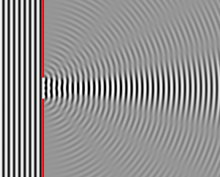
One of the interesting properties of sound waves is that they can diffract like the image below demonstrates.


The possibility of hearing around corners or barriers involves diffraction and reflection of sound. Diffraction is mostly associated with longer wave lengths as thus implies that you hear low frequencies than higher ones. This is also explained by the fact air absorbs higher frequencies better than lower ones. A lightning strike for instance has a high crackle with a longer low rumble.

Sound proofing rooms takes this into account and so the room has to be fully sealed because diffraction can disrupt a lot from the smallest gaps. This is a similar reason for loud speakers to be sealed so they maximise output. 

An interesting characteristic involving imaging. When a wavelength is longer than an obstacle, for instance a pillar means you can't see the obstacle. This is the same reason you cant see a virus under a light microscope because the virus is smaller than the waves of light. This is due to the bigger wavelength diffracting round the obstacle and reconstructing past it. 


See also: Refraction

Feel free to comment,


Thanks,

Matt Price

Reverberation Time

A reverberant sound in any closed space like a room or concert hall diminishes as the sound energy is absorbed by multiple interactions with the surfaces of the room. Though the speed it takes to diminish depends on the variable of the rooms surfaces, for instance a reflective  or "live" room will take longer than a very absorbent or "dead" room. The time for the sound to completely die away will depend how loud the sound is at the start and how well the observer hears. 


The standard reverberation time has be established as the time it takes for a sound source to diminish by 60 dB below its original level. This is established at 60dB from testing in auditoriums where the loudest crescendo in an orchestra is 100dB and typical background noise for a music-making area being around 40dB. 60dB is also roughly the dynamic range for orchestral music.


In terms of time it depends on the rooms use. In a classroom you want the room to have low reverberation time to keep articulation clear and reduce build up from people talking. In an auditorium you probably want a bit more so you can really feel the music. As a general rule you wont get long reverberation time in a small room because of how fast the energy is bouncing off the surfaces and being absorbed a bit each time.


Reverberation time is just one part in creating pleasing environments for sound, you also need to consider the absorption in terms of frequencies.


Thanks,


Matt Price

Inverse Square Law Of Sound

Hello All,


This blog is on the inverse square law of sound which is a very important law that not many really know about (we will get onto that later) Sound waves propagate spherically and so distributed over and ever increasing surface of diameter at the front surface of the wave. The inverse square law tells us that every doubling of the distance from the sound source in a free field situation the sound pressure level will diminish by 6 decibels.


Why many may not know this law is that it is hard to get a free field situation such as an explosion of a bomb in mid air. Though not perfect for real life situations it is a very important guide to sound sources and how they diminish over distance. 


As an example lets say a person shouts at 70dB at 3 feet away from you in a room, at 6 feet it will be 62dB and at 12 feet 56dB and at 24 feet 50dB. This example on works as a guide not taking into account reflections from any walls of a room and any other sound in the room at the time of shouting.


Thanks,


Matt Price

World-a-lies-ing

Instead of you having to read everything like back in the 1800's i thought i would indulge all your senses to a quick video interview with Walter Murch. I will write up another blog that will go into more detail about different types of reflections of sound off surfaces and all of that jazz later today as i have just a few more days till im back on several shoots. Enjoy!
Manipulating sound until it seemed to be something that existed in real space. This refers to playing back existing recordings through a speaker or speakers in real-world acoustic situations, and recording that playback with microphones so that the new recording takes on the acoustic characteristics of the place it was "re-recorded." [via filmsound.org]

Thanks,

Matt Price

Monday, 25 July 2011

Q+A: What is difference between room tone, ambience, wild sound?

Hey,

These definitions vary depending who you are so this is ONLY a guide =].

Room Tone: This is the natural sound that a room "makes" from the natural reflections in the room. This is important for being able to patch over areas of sound so make sure you GET IT AFTER THE SCENE and hold your microphones ideally in the exact same locations.

Ambience: This is similar to room tone as it is the natural environment. However what makes it more specific is can be illustrated with an example of a scene in a restaurant where people are in the background, you will want to collect the general ambience (atmos) to again be able to patch over any gaps in post production.

Wild Sound: This can be any sound that doesn't need to be recorded in sync and is usually an object such as a fridge in a kitchen.

Feel i have missed anything? Then just comment =]

Thanks,

- Matt Price