Blog Moving!!

IMPORTANT: This Blog Is Moving To My Website HERE and Updated with new Items. I will keep this active but it will not have any new content on it. Thank you for your support.

Labels

1860 (1) 1877 (1) 5.1 (3) 664 (1) 7.1 (1) adr (1) ambience (6) amp (1) amplification (2) amplitude (5) au clair de la lune (1) audio (20) balanced (3) batteries (1) battery (1) bit depth (5) cables (3) carbon microphone (2) compression (1) Condenser Microphones (3) critical angle (1) cycles per second (1) data rate (5) dB (1) dBa (1) dead spot (1) Decibels (1) definition (23) diffraction (1) Digital (1) directory (6) dither (1) documentary (3) Dolby (2) Dolby Digital (2) DTS (2) dubbing (2) dynamic microphone (3) dynamic range (1) edison (1) electromagnetism (1) equipment (3) equipment demo (1) ew 100 (1) explained (43) feedback (1) festivals (1) film crew pro (1) Film history (4) film jobs (2) Film Sound (42) film work (6) frequency (6) glossary (1) Heinrich Rudolf Hertz (1) help (1) Hertz (5) history (2) home cinema (1) How does it work? (28) hz (1) information (2) information on sound (4) Introduction (10) key features (1) law (1) laws (8) levels (1) looping (2) lossless (1) lossy (1) mAh (1) mandy (1) matt price (1) metadata (1) Meters (1) Mic Specs (1) microphone (7) ohm (1) paid film work (2) parabolic reflectors (1) pcm (1) phase (1) phasing (1) phonautograph (1) phonograph (1) physicist (1) PPM (1) Preproduction basics (2) quantization error (1) question and answers (1) questions and answers (26) radio microphone (2) reference (3) refraction (3) resource (12) reverb (7) review (1) room tone (6) sampling theorem (2) senhiesser (3) sensitivity (1) shoeps (1) something to watch (7) sound (3) sound basics (2) sound devices (1) sound equipment (16) sound news (1) sound pressure level (3) sound recording (25) sound wave (4) space (1) speaker systems (1) speed of sound (4) SPL (1) SUPER CMIT (1) surround (1) talent circle (1) technical (16) theory (16) transducer (1) unbalanced (1) unit of measurement (1) VU (1) walter murch (1) wave agent (1) websites (1) wild sound (5) wilhelm scream (1) worldizing (1) XLR (2)
Showing posts with label How does it work?. Show all posts

Thursday, 1 March 2012

7.1 will become the new standard

Speaker systems for your home theatre are usually your normal 5.1 setup with either Dolby or DTS that runs it all. (find out more about Dolby vs DTS here)

You have your 5 surround speakers (center bar, front L+R and rear L+R with the .1 being the subwoofer for those deep "end of the world" disasters etc..)

This is great for being able to follow that transformer running across screen or that slow motion bullet passing by but thats still all based around the front to enhance the visual actions or presence on screen if you're in that sweet spot in the middle of the square speaker setup.

Now with 7.1 its a more "real" world environment with 2 extra speakers (making 7.1) at the rear sides  Left + Right. This giving you a full surround sound experience as there is much better coverage from the sides. In 7.1 that helicopter swooping round to destroy that enemy will really feel like its not just jumping from front to the rear but thundering all the way round!

In the interest of only using my own work you will have to put up with my terrible drawing.


If you want more info then watch this DTS-HD presentation on youtube

Thanks for viewing and please tweet, like or +1 to share the info and resources in the blog, Matt Price.

Monday, 27 February 2012

Production Sound Mixer Video Interviews

Underneath all this typing it's sometimes nice to have a few videos to just watch and listen. Some of the rarest to find in the masses and masses of rubbish on youtube are some interviews with sound mixers (there the guys with boom operators) and sound recordists (they do both)


Desktop Computer Users and Mobile users just use the player below and further down is help to better your experience! If you like the video collection then please "Like" the playlist so more can find it, Thanks Again.


Below is a screenshot for the best user experience on your PC, Mac or mobile.
The Blue Circle Is For Full Screen Then Click The Red Circle For The Full Playlist

Heres another great one from Vimeo,


Friday, 30 September 2011

Dither and Quantization Error

Dither is an internationally applied form of noise used to randomize quantization error, preventing large scale patterns such as "banding" in images. 
Example of image "Banding"


Dither is routinely used to processing both digital audio and digital video data and usually one of the last stages in post production for compact discs. 

Quantization Error is the difference in the actual analog value and the quantized digital value. This is due to either rounding of digital views or truncation. The error is sometimes considered as an additional random signal called quantization noise because of its "stochastic" or non-deterministic behavior

Cheers Guys,

Matt Price

Sunday, 21 August 2011

Phase and Interference...

What is wave interference?
when two or more waves from different sources are present at the same time in the same space to create a new wave. The more useful part of this question is what happens and what types there are...
Constructive Interference
when the compressions and the rarefactions match they create a wave of higher intensity.
Destructive Interference
When the waves are out of phase, as in the opposite to constructive interference but the sound is louder in some places and softer in other places. Often leading to pulses and beats of sound.
What is a Phase?
Phase in waves is the fraction of a wave cycle which has elapsed relative to an arbitrary point.

What is Phasing?
The relationship between the waves to form the new wave, often used to describe the resulting sound, commonly constructive or destructive.
Dead Spots?
This is where the compression of one wave matches or is in phase with the rarefaction of another and so the sound is cancelled out and nothing is heard.
What else to consider?
Sound waves also change speed due to rarefaction from entering different mediums such as air to water, thus changing angle and bending the wave. this leads onto:
The critical angle..
When a waves entering angle reaches a certain point it's called the critical angle. The rarefaction is parallel to the dividing line between the mediums. The greater the difference in speed from the sound in the two mediums, the greater the critical angle.
What does this mean?
If the sound hits the new medium with any angle smaller then the critical angle it will not be able to enter and so be reflected from the dividing line. Even if it enters the medium some will be reflected because of waves rarely propagate in straight lines only.
Example...
A wave travelling through the air hits a building at 20 degrees, which for this example is less than the critical angle, then it is all reflected at 160 degrees as the total angle is 180 degrees of the wall.
If the wave is above the critical angle then most will enter the brick and speed up because the molecules are closer and so is refracted. The rest bouncing off because it won't all be entering with in the critical angle. 

Hope this all flowed nicely,
Thanks,
Matt Price

Friday, 19 August 2011

Quick Note About Digital Microphones...

As we know, or should by now, analogue microphones are based on the same concept as our ears, this is the most effective way to actually hear because sound waves have no formula when it comes to multiple sources and are all added together depending on so many different circumstances that it is impossible to hear digitally, unless we get a chip in our brains to convert it some how it is a long long way off....

So what are digital microphones?

These beauties like the Shoeps SuperCMIT are really the future. They still are not completely digital for reasons above but have a digital transducer instead of going all the way down analogue cabling to be converted. This allows the signal effectively at source to be effectively set up so then your mixer/recorder can do even more with it in terms of collecting that sweet sweet sound.

So keep a look out for them because they will slowly become the norm, after all your not recording onto DAT tape i bet.

Thanks,

Matt


Thursday, 18 August 2011

5.1 Surround Sound, Dolby or DTS?

This is section explaining what Dolby Digital 5.1 and DTS 5.1 are, along with a bit about why people think one is better than the other etc...

What is 5.1?
Refers to this speaker set up: (left front, left rear, right front, right rear, and center), plus a subwoofer channel (the .1 in 5.1)

What is Dolby Digital Surround Sound?
This is the most common format for surround sound on media such as movies. Its a discrete channel surround sound format because the output has been controlled to come from a variety of speakers, allowing a car to sound like it is moving across the screen etc....

What is DTS?
DTS (Digital Theater Systems) is a digital surround-sound system first introduced in theaters in 1993. DVDs encoded with a DTS soundtrack require a DVD player and stereo receiver equipped with DTS-processing capability. This is partly due to the DTS demands for more data space on a DVD (often sacrificing bonus features), but many believe the audio quality to be superior to that of Dolby Digital 5.1-channel surround sound.

What do people think?
I don't happen to be 'the people' but reading up and around the issue DTS has a higher data rate and so that roughly translates into 'better' sound. Where as many Dolby fans argue that low compression but higher data rate provides 'better sound'....

Ill need another 10 years to provide a better description of 'better sound' but many blogs start with the underdog against the giant, like in all fairy tales...

I should be pointed out that both Dolby Digital and DTS Digital Surround encoding schemes now have even higher sampling rate of 48 kHz at 20-bits per sample, thus yielding an even wider dynamic range between sound level extremes of approximately 120dB.

They both have to be compressed in some form to fit on the disk so that is always going to be an issue, raw data over efficiency is hard to prove when sound is subjective.

"Compression and bit-rate are not the only differences when comparing Dolby vs. DTS formats. For example, the added rear surround channel in Dolby's extended surround format 'Dolby Digital EX', is matrixed over the two left and right surrounds, rather than discrete; instead the DTS counterpart uses a discrete channel. This also explains why DTS ES (Extended Surround) can provide a more precise location for the rear-effects soundstage than the Dolby EX format." - Source here

"Both Dolby Digital and DTS audio are capable of achieving similar end results in delivering surround sound, even though the lower compression/higher bit-rate of DTS Digital Surround should theoretically yields apparent benefits in sound quality.

At the same time, one cannot ignore the fact that these two formats make use of different coding schemes and syntax to perceptually compress audio.

This means that efficiency in terms of data utilization between these two formats is different. Therefore, a Dolby vs. DTS direct comparison based solely on these formats raw bit rates cannot be taken as a measure of sound-quality.

Thus, while it is objectively possible to compare the resultant sound quality for the same audio format encoded at different bit rates, and therefore, to determine whether the same format in a moviehouse application sounds better or worse than in a consumer implementation in home entertainment, it is not so straightforward when dealing with different formats.

Rather, the reality is that for identically sourced audio content, it would be much easier for the listener during a Dolby vs. DTS 'blind' listening test to notice a change in sound quality when changing the playback equipment say between different brands, than when changing from a Dolby Digital to the DTS surround audio track." - Source here


So it is down to choice really and if it you set up your theatre, home cinema etc... then you might notice one suiting your needs better, Sadly this is going to be a never ending debate but at least you can argue both ways forever with your friends.

Thanks

Matt Price

Sunday, 14 August 2011

Sampling theorem


The Nyquist–Shannon sampling theorem, after Harry Nyquist and Claude Shannon, is a fundamental result in the field of information theory, in particular telecommunications and signal processing. Sampling is the process of converting a signal(for example, a function of continuous time or space) into a numeric sequence (a function of discrete time or space).

Sampling theorem which in essence shows that a bandlimited analog signal can be reconstructed perfectly from an infinite sequence of samples if the sample rate exceeds 2B samples per second. B is the highest frequency in the original signal. If the signal contains components at exactly B hertz, then samples spaced 1/(2B) seconds do NOT completely determine the signal.

E.g. 20,000 Hertz into this forumla will not be reconstructed perfectly at anything less than 0.00003 seconds per sample. Recording at a sample rate of 48kHz is sampling at 0.00002 seconds per sample, hence for situations like recording dialogue where the highest frequency for normal conversation is below 20kHz (because we can't hear higher).

Possibly Useful Drawing of a 2hz sine wave


So in recording effects if you wanted to have flexibility to manipulate then you can record at 192kHz and then the spacing is 1 sample every 0.0000052083 of a second, this is useful for slowing down samples more effectively than less samples.

This is again like most perfect theories based on a perfect world and so is an approximate in our not so perfect world.

Hope this ended up making sense.

Thanks,

Matt Price

Transducer

A transducer is a device that converts one type of energy to another. Energy types include electricalmechanicalelectromagnetic (including light), chemicalacoustic or thermal energy and many more. While the term transducer commonly implies the use of a sensor/detector, any device which converts energy can be considered a transducer.


So a microphone is considered a transducer because it turns acoustic energy into electrical energy.


Thanks,

Matt Price

Ohm ohm ohm... amp?

Ohm's or Î© is the SI or system of international unit of electrical resistance and gets it's name from Georg Simon OhmOhm determined that there is a direct proportionality between the potential difference (voltage) applied across a conductor and the resultant electric current. This relationship is now known as Ohm's law.

So an Ohm is a unit of resistance between two points of a conductor when, for instance, a constant 1 volt difference is applied to each point and it produces 1 ampere.

Ampere  It is named after André-Marie Ampère (1775–1836), French mathematician and physicist, considered the father of electrodynamics. In practice, its name is often shortened to amp. An amp is a SI for basically a rate of flow in a wire. 

So an ohm is just a way of measuring how easily electricity flows along a certain path. Electrical resistance shares some conceptual parallels with the mechanical notion of friction.

Leave comments if still confused =]

Thanks,

Matt Price

Tuesday, 9 August 2011

The famous Wilhelm scream

The Wilhelm Scream originates from the film Distant Drums in 1951. The scene in the video below soliders are wading through a swamp and one (Wilhelm) gets bitted and dragged underwater by an aligator, the scream was re-recorded in a single take, along with 5 others. the 4th 5th and 6th are also used earlier in the movie. 4-6 are all recognisable as the Wilhelm scream by many sound editors.


Below is the scene with the original Wilhelm Scream.


Below is a compalation of Wilhelm screams


Hope you enjoyed this,

Thanks,

Matt Price

Thursday, 28 July 2011

Refraction

This is the bending of waves when they enter a medium where their speed is different. This is less important than refraction of light as it affects image formation of images by lenses and eyes etc... 


If we use the example illustrated above shows that the first medium of air the light travels straight but when it hits the second medium of the glass it bends depending on which side hits the second medium first, it will bend left if the left side hits the second medium and slows down and refracts. 


Not only the direction changes but separation of the waves decreases as the frequency of the waves does not change by its source but the shower speed must shorten the wavelength.


This is also interesting in sound because if the air above the earth is warmer than the surface, sound will bend back downwards towards the surface by refraction. If the air above the earth is warmer than that at the surface, sound will be bent back downward toward the surface by refraction.


Refraction also amplifies sound sometimes over cool lakes in the morning. The water keeps the air cool near the water but as the sun comes up it heats the air higher up creating a thermal inversion. The speed of sound is faster in the warmer air and so bends some sound back towards you.


also see: Diffraction


Thanks,


Matt Price

Diffraction

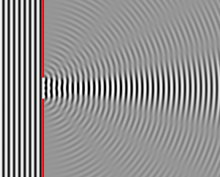
One of the interesting properties of sound waves is that they can diffract like the image below demonstrates.


The possibility of hearing around corners or barriers involves diffraction and reflection of sound. Diffraction is mostly associated with longer wave lengths as thus implies that you hear low frequencies than higher ones. This is also explained by the fact air absorbs higher frequencies better than lower ones. A lightning strike for instance has a high crackle with a longer low rumble.

Sound proofing rooms takes this into account and so the room has to be fully sealed because diffraction can disrupt a lot from the smallest gaps. This is a similar reason for loud speakers to be sealed so they maximise output. 

An interesting characteristic involving imaging. When a wavelength is longer than an obstacle, for instance a pillar means you can't see the obstacle. This is the same reason you cant see a virus under a light microscope because the virus is smaller than the waves of light. This is due to the bigger wavelength diffracting round the obstacle and reconstructing past it. 


See also: Refraction

Feel free to comment,


Thanks,

Matt Price

Reverberation Time

A reverberant sound in any closed space like a room or concert hall diminishes as the sound energy is absorbed by multiple interactions with the surfaces of the room. Though the speed it takes to diminish depends on the variable of the rooms surfaces, for instance a reflective  or "live" room will take longer than a very absorbent or "dead" room. The time for the sound to completely die away will depend how loud the sound is at the start and how well the observer hears. 


The standard reverberation time has be established as the time it takes for a sound source to diminish by 60 dB below its original level. This is established at 60dB from testing in auditoriums where the loudest crescendo in an orchestra is 100dB and typical background noise for a music-making area being around 40dB. 60dB is also roughly the dynamic range for orchestral music.


In terms of time it depends on the rooms use. In a classroom you want the room to have low reverberation time to keep articulation clear and reduce build up from people talking. In an auditorium you probably want a bit more so you can really feel the music. As a general rule you wont get long reverberation time in a small room because of how fast the energy is bouncing off the surfaces and being absorbed a bit each time.


Reverberation time is just one part in creating pleasing environments for sound, you also need to consider the absorption in terms of frequencies.


Thanks,


Matt Price

Q+A: 6 Miscellaneous Sound Questions... Part 1

Compilation of general and random questions...

1. What does 94.1 mean on a radio dial?
This mean the station is emitting at 94.1 million Hertz or 94,100,000 waves per second.

2. If sound becomes louder, what wave characteristics increase? frequency, wavelength, amplitude or speed?
Only amplitude.

3. How much bigger is a sound at 40dB compared to 0dB? 
10,000 times.

4. How much bigger is a sound at 110dB compared to 50dB?
1,000,000 times.

5. What does supersonic mean? 
Faster than the speed of sound

6. General speeds according to (this site)

WATER:
Distilled water = 1489 m/sec
Sea Water = 1531 m/sec (higher because it is denser)

WOOD:
Ash, along the fiber = 4670 m/sec
Ash, across the rings = 1390 m/sec, about 3 times slower, and a little slower
than the speed of water!
Beech, along the fiber = 3340 m/sec
Elm, along the fiber = 4120 m/sec
Maple, along the fiber = 4110 m/sec
Oak, along the fiber = 3950 m/sec.


Thanks,


Matt Price

Inverse Square Law Of Sound

Hello All,


This blog is on the inverse square law of sound which is a very important law that not many really know about (we will get onto that later) Sound waves propagate spherically and so distributed over and ever increasing surface of diameter at the front surface of the wave. The inverse square law tells us that every doubling of the distance from the sound source in a free field situation the sound pressure level will diminish by 6 decibels.


Why many may not know this law is that it is hard to get a free field situation such as an explosion of a bomb in mid air. Though not perfect for real life situations it is a very important guide to sound sources and how they diminish over distance. 


As an example lets say a person shouts at 70dB at 3 feet away from you in a room, at 6 feet it will be 62dB and at 12 feet 56dB and at 24 feet 50dB. This example on works as a guide not taking into account reflections from any walls of a room and any other sound in the room at the time of shouting.


Thanks,


Matt Price

World-a-lies-ing

Instead of you having to read everything like back in the 1800's i thought i would indulge all your senses to a quick video interview with Walter Murch. I will write up another blog that will go into more detail about different types of reflections of sound off surfaces and all of that jazz later today as i have just a few more days till im back on several shoots. Enjoy!
Manipulating sound until it seemed to be something that existed in real space. This refers to playing back existing recordings through a speaker or speakers in real-world acoustic situations, and recording that playback with microphones so that the new recording takes on the acoustic characteristics of the place it was "re-recorded." [via filmsound.org]

Thanks,

Matt Price

Tuesday, 26 July 2011

Sound Pressure Level and Decibels

Sound Pressure Level is the amount of air pressure fluctuation a sound source creates. We perceive this pressure in terms of loudness. A simple example is a drum, when you hit it gently the surface doesn't move very far and so because the of this the pressure is lower than hitting it hard.
The pressure is also effected by where the listener is from the source and the environment they are in. A drum hit hard in a small bathroom will sound a lot louder than a drum in a cathedral because many of the discrete reflections will never reach the listener due to the expanse of the space. This is obviously even less in an open field where there is nothing to reflect off in the sky.


Sound pressure is usually expressed as pascals (Pa). Usual conversation pressure is 0.02 Pa and a petrol lawn mower is around 1 Pa and sound becomes painful at around 20 Pa. So a healthy range is around 0.00002 to 20 Pa. 


Pressure ranges obviously offer such a wide range of scale that we use the decibel scale. This is because it compresses the scale into a manageable range. This conversion from sound pressure to the decibel scale is called sound pressure level.


0dB is 0.00002 Pa and this is the start of the scale.


This is redrawn on paper due to copyright and is still an accurate reference.


Thanks,


- Matt Price

Microphone Polar Patterns...

This outlines the types of polar patterns. Polar patterns are the field of focus that the microphone will pick up due to the position of the diaphragm and other factors.


0 degrees is straight infront of the microphone, 180 degrees is directly behind the microphone


Omni Directional
This encompasses a field of all directions, or nondirectional. In theory it should be a perfect sphere but because the microphone its self is not infinitely small it gets in its own way, just like if it was on a persons body. So the smaller the body the better the polar pattern. The wave length of 10Khz is 3.4cm so small microphones are effective at even high frequencies.


Cardiod

This is the most common unidirectional microphone. There is a dip at the back due to the microphone casing and the direction of the diaphragm. A Sub cardiod is similar to the omnidirectional polar pattern but flatter. and Super and Hyper cardiod have tighter patterns compared to the basic cardiod pattern, but they add more sensitivity to the cardiod because of there higher sensitivity.

Shotgun
These are the highest directional microphones. They have small fields of sensitivity to the left, right and rear. This is still significantly smaller than other directional microphones. This is the most common on film sets for booming over subjects.


See Also: Condenser Microphones, Dynamic Microphones and Carbon Microphones.


images are free to reuse via wikipedia

Thanks,

- Matt Price

Parabolic Refectors

A Parabolic microphone is a microphone with a parabolic reflector fitted to it. This collects and focuses sound on the microphones head like a TV dish picks up satellite signals. This has many advantages for picking up and amplifying distant sounds that you want to isolate from the rest of the environment. A classic example is bird song because parabolic reflectors are very good at picking up high frequencies. this is also used in sports broadcasting, eavesdropping and espionage. 
The high frequencies are picked up more due to the direct physical laws of sound waves. This is because they only focus waves with a wave length much smaller than the diameter of the parabola. To obtain hi-fidelity sounds including the lower end frequencies (down to 20Hz) you need a parabola around 17 metres. This is because if we say the speed of sound is 342 m/s through the air (speed of sound) 342 ms / 20 Hz = 17 metres. Parabolic reflectors will sacrifice the lower end frequencies to be more manageable sizes.


Representation of how a reflector works with microphone facing the central point  for maximum pickup.


Thanks,
- Matt Price

Q+A: Sample rates explained....

Sample rate is the number of samples per unit of time taken from a continuous signal to make a discrete signal, the unit of sample rates are Hertz. We record a discrete signal because we only need lots of little samples of the signal to track how loud it is etc... So the higher the samples the more of these measurements are taken per second. The standard for recording dialogue is 48kHz (48,000 hz) or 44.1kHz and unless your playing on really nice speakers you really wont be able to tell the difference.

For some sound effects recording people record at 192kHz which has advantages for slowing effects down and manipulating them. Also higher sample rates help prevent aliasing, which refers to an effect that causes different signals to become indistinguishable 


also see: Bit Depth

Thanks,

- Matt Price