Blog Moving!!

IMPORTANT: This Blog Is Moving To My Website HERE and Updated with new Items. I will keep this active but it will not have any new content on it. Thank you for your support.

Labels

1860 (1) 1877 (1) 5.1 (3) 664 (1) 7.1 (1) adr (1) ambience (6) amp (1) amplification (2) amplitude (5) au clair de la lune (1) audio (20) balanced (3) batteries (1) battery (1) bit depth (5) cables (3) carbon microphone (2) compression (1) Condenser Microphones (3) critical angle (1) cycles per second (1) data rate (5) dB (1) dBa (1) dead spot (1) Decibels (1) definition (23) diffraction (1) Digital (1) directory (6) dither (1) documentary (3) Dolby (2) Dolby Digital (2) DTS (2) dubbing (2) dynamic microphone (3) dynamic range (1) edison (1) electromagnetism (1) equipment (3) equipment demo (1) ew 100 (1) explained (43) feedback (1) festivals (1) film crew pro (1) Film history (4) film jobs (2) Film Sound (42) film work (6) frequency (6) glossary (1) Heinrich Rudolf Hertz (1) help (1) Hertz (5) history (2) home cinema (1) How does it work? (28) hz (1) information (2) information on sound (4) Introduction (10) key features (1) law (1) laws (8) levels (1) looping (2) lossless (1) lossy (1) mAh (1) mandy (1) matt price (1) metadata (1) Meters (1) Mic Specs (1) microphone (7) ohm (1) paid film work (2) parabolic reflectors (1) pcm (1) phase (1) phasing (1) phonautograph (1) phonograph (1) physicist (1) PPM (1) Preproduction basics (2) quantization error (1) question and answers (1) questions and answers (26) radio microphone (2) reference (3) refraction (3) resource (12) reverb (7) review (1) room tone (6) sampling theorem (2) senhiesser (3) sensitivity (1) shoeps (1) something to watch (7) sound (3) sound basics (2) sound devices (1) sound equipment (16) sound news (1) sound pressure level (3) sound recording (25) sound wave (4) space (1) speaker systems (1) speed of sound (4) SPL (1) SUPER CMIT (1) surround (1) talent circle (1) technical (16) theory (16) transducer (1) unbalanced (1) unit of measurement (1) VU (1) walter murch (1) wave agent (1) websites (1) wild sound (5) wilhelm scream (1) worldizing (1) XLR (2)
Showing posts with label sound recording. Show all posts

Monday, 27 February 2012

Oldest Known Recording Unearthed From 1860

Previously the oldest recorded sound was thought to be Edison's phonograph recording of a children's nursery 

rhyme "Mary had a little lamb.." in 1877. So what did they use before the phonograph?

The "phonautograph", is used by etching paper covered in soot. US scientists used a virtual stylus to read the lines. The recording was found by audio historian David Giovannoni who said to the Associated Press "When I first heard the recording as you hear it ... it was magical, so ethereal,"

"The fact is it's recorded in smoke. The voice is coming out from behind this screen of aural smoke."

The phonautograph was made by a Parisian inventor, Edouard-Leon Scott de Martinville. The new recording will be presented on 28 March at a conference of the Association for Recorded Sound Collections at Stanford University in California.


The video below is the 10 second clip of "Au Clair de la Lune".


This is the video of Edison's recording of "Mary had a little Lamb"


Thanks

Production Sound Mixer Video Interviews

Underneath all this typing it's sometimes nice to have a few videos to just watch and listen. Some of the rarest to find in the masses and masses of rubbish on youtube are some interviews with sound mixers (there the guys with boom operators) and sound recordists (they do both)


Desktop Computer Users and Mobile users just use the player below and further down is help to better your experience! If you like the video collection then please "Like" the playlist so more can find it, Thanks Again.


Below is a screenshot for the best user experience on your PC, Mac or mobile.
The Blue Circle Is For Full Screen Then Click The Red Circle For The Full Playlist

Heres another great one from Vimeo,


Wednesday, 22 February 2012

Heinrich Rudolf Hertz - 155th Birthday

Well would be but sadly died at the age of 36! But didn't take him long to see what everyone else couldn't.

Im sure you have guess the young German electronic engineer and physicist who clarified and expanded the electromagnetic theory of light introduced by James Maxwell publishing his theory in 1865. Maxwell was also phenomenal is creating a theory from seemingly unrelated experiments and studies of electricity, magnetism and optics and combined them. He was also known for the first durable colour photograph earlier in 1861 and even did foundation work on rigidity for bridges, and is considered one of the greatest physicists of all time.

Back to our friend Heinrich Rudolf Hertz. He was the first to prove with immense certainty the presents of electromagnetic waves by designing and engineering instruments to transmit and receive radio pulses using procedures to discredit other sources of wireless phenomenon. As such his name was given to the unit of frequency known as, you guessed it Hertz (Hz)


Just So I Don't Breech Copyright :)
See a better image of him from Wikipedia


Saturday, 18 February 2012

Recording Meters and Levels


Hello There,

When i started out in Sound Recording i was confused by the different meters and how you can record at -dB, surely that was impossible? Why record at -12dB on a digital system but aim for 6 on a VU meter? So here is a run down of what it all means.

Digital Systems compared to analogue systems


Digital is obviously here to stay for many reasons but an important note in terms of levels are how the different systems deal with very loud signals.

Sound is always analogue at the source and how we hear it only in between can it be digital.

Analogue recording systems gracefully handle extremely loud signals and slowly get completely messed up. Digital on the other hand just cuts off and dies horribly!. This is due to Sampling theorem and the Dynamic Range of data that can be stored on a sample before it starts to distort. Thus it is very important to have headroom and understand your meter system.

Digital Meters

These range from around -60dB up to 0dB. The zero has no actual value other than the loudest sound that can be free of distortion. When measuring in just dB it is only a representative change like a percentage or ratio compared to another value.

Example: If i said his voice was 20dB higher then hers, it would be his voice is 10 times louder than hers. Just saying my voice is 10dB means nothing unless compared to something else, if i said my voice should be at 10dBu or dBA then it means something. (But it will get it`s own topic soon)

Meters!!


These are different standard for playback purposes and final mixes of program but easily applied to production recording devices.


PPM (Peak Programme Meter - BBC)
Range = 0 to 7
line-up: 4 (needle straight up)
Max level: 6
Each division: 4dBs
Average level: 5
Edit suite/CTA measurement


See a real version of a PPM meter system 


VU (Volume Units - USA)
line up:-4 (between 3 & 5 black)
Max level: +4 (Red notch right of 3)
Each division: 1dB
Average level: 0
Analogue VTRs


See real example of VU meter system


Digital
line up: -20
Max level: 0
Each division: Varies
Average level: -14
Digital VTRs, Digital Recorders

See real example of Digital Meter System


As always i hope this answers everything and if not drop a comment below and i shall amend it asap.

Cheers,

Matt

www.soundrolling.com

Don't Forget to +1 This Below

Thursday, 19 January 2012

Sound like a bass smurf on Venus...


Above are some recordings that scientists from Southampton University created to replicate how different environments and objects sound on other worlds and moons.


Prof Leighton, who has been working on the sounds of space for the last ten years and commented ''When we hear a voice from Venus, we think the speaker is small, but with a deep bass voice. On Venus, humans sound like bass Smurfs.'

Despite many years of space exploration, scientists have no evidence of the sound of other planets. While most planetary probes have focused on imaging with cameras and radar and a couple have carried microphones, none of them successfully listened to the sound of another world.

Interesting non the less

Thanks for reading

Wednesday, 19 October 2011

5 Basics For Location Sound Pre Production Part 1

Hello all,
It has been a while so I shall treat you to this blog covering 5 very basic things to cover in PREPRODUCTION for your location shoot.
This is for both sound peeps and production!

1. Location scouting
Always ask questions about sound at different times of day/night in any location and preferably try and go at peak hours of traffic to assess the worse case senario. if your there at 3am on a sunday but your shoot is 5pm on a friday its going to sound very different

2. Carpet and cloth blankets
echo (revereration time) from 'live' (hard, reflective surfaces) needs to be covered or as I like to say killed to create a 'dead' (very low revereration time) room or space even if you like it that way! !
Remember lots of gaffer for air conditioning vents etc... The carpet can be for crew to walk on as they never stay rigidly still.

3. Have an arsnel of microphones
With not just cardiod boom mikes (ntg2) but hypercardiod (senn 416) and even hire in mikes on certain days that are needed. Remember directors and production people: location sound is the best investment in terms of its value of return.

4. Sound report sheets
I may post some examples later but use a sensible sound report sheet for not just your own skin but for the poor editors who can easily see in the edit whats good, whats bad and why, even write when directors over turned any desicions and even leave feedback at the end of sound takes to help other sound editors. Slate everything and try to always push to clap at the front and not the end of a take.

5. Get a boom op...
This will help everyone out from setting up rooms for sound to miking actors and allow the recordist to focus on the quality of the sound! They arn't just a fancy mike stand showing off their muscles and eating all your food but good ones are usually sound recordists as well, two heads are better than one... Or at least 4 hands are better than 2 :-)
Continue to 5 more preproduction basics for location sound.
This concludes the first 5 basics to do in PREPRODUCTION, dont be shy to share this article if you know the production can benefit from these 5, CAUSE THEY CAN :-)
Thanks,
Matt Price

Sunday, 14 August 2011

Sampling theorem


The Nyquist–Shannon sampling theorem, after Harry Nyquist and Claude Shannon, is a fundamental result in the field of information theory, in particular telecommunications and signal processing. Sampling is the process of converting a signal(for example, a function of continuous time or space) into a numeric sequence (a function of discrete time or space).

Sampling theorem which in essence shows that a bandlimited analog signal can be reconstructed perfectly from an infinite sequence of samples if the sample rate exceeds 2B samples per second. B is the highest frequency in the original signal. If the signal contains components at exactly B hertz, then samples spaced 1/(2B) seconds do NOT completely determine the signal.

E.g. 20,000 Hertz into this forumla will not be reconstructed perfectly at anything less than 0.00003 seconds per sample. Recording at a sample rate of 48kHz is sampling at 0.00002 seconds per sample, hence for situations like recording dialogue where the highest frequency for normal conversation is below 20kHz (because we can't hear higher).

Possibly Useful Drawing of a 2hz sine wave


So in recording effects if you wanted to have flexibility to manipulate then you can record at 192kHz and then the spacing is 1 sample every 0.0000052083 of a second, this is useful for slowing down samples more effectively than less samples.

This is again like most perfect theories based on a perfect world and so is an approximate in our not so perfect world.

Hope this ended up making sense.

Thanks,

Matt Price

Transducer

A transducer is a device that converts one type of energy to another. Energy types include electricalmechanicalelectromagnetic (including light), chemicalacoustic or thermal energy and many more. While the term transducer commonly implies the use of a sensor/detector, any device which converts energy can be considered a transducer.


So a microphone is considered a transducer because it turns acoustic energy into electrical energy.


Thanks,

Matt Price

Friday, 5 August 2011

ADR, dubbing, looping and post sync

All the names in the title mean the same thing roughly. Though you should be aware that you can dub on music to a film. ADR stands for automated dialogue replacement, this is the post production process for replacing the lines, words, sentences of dialogue with a new copy or different lines. 

This is for various reasons which include but are not limited to: Poor recording on set, pops and clicks that can't be cleaned, wrong lines, poor performance and so on... This is usually hell for many directors, actors and crew because it is time consuming and so expensive, coupled with the fact the voice has to match the performance even though the time from the actual recording to the ADR session could be months or even years!. 

Foreign films obviously get dubbed in the language of the country they are being distributed to and so don't necessarily need to be in perfect sync. Though across Europe different countries have different rules, naturally. as seen on this map here.

Looping is also a name for dialogue replacement as the lines that need to be retaken will be done over several takes so the actor can get into the rhythm of the piece and deliver a better performance.


This is was a brief one as im in between filming,

Thanks for viewing, comments appreciated,

Matt Price

Thursday, 28 July 2011

Refraction

This is the bending of waves when they enter a medium where their speed is different. This is less important than refraction of light as it affects image formation of images by lenses and eyes etc... 


If we use the example illustrated above shows that the first medium of air the light travels straight but when it hits the second medium of the glass it bends depending on which side hits the second medium first, it will bend left if the left side hits the second medium and slows down and refracts. 


Not only the direction changes but separation of the waves decreases as the frequency of the waves does not change by its source but the shower speed must shorten the wavelength.


This is also interesting in sound because if the air above the earth is warmer than the surface, sound will bend back downwards towards the surface by refraction. If the air above the earth is warmer than that at the surface, sound will be bent back downward toward the surface by refraction.


Refraction also amplifies sound sometimes over cool lakes in the morning. The water keeps the air cool near the water but as the sun comes up it heats the air higher up creating a thermal inversion. The speed of sound is faster in the warmer air and so bends some sound back towards you.


also see: Diffraction


Thanks,


Matt Price

Diffraction

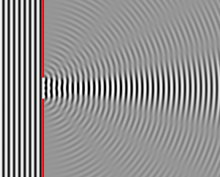
One of the interesting properties of sound waves is that they can diffract like the image below demonstrates.


The possibility of hearing around corners or barriers involves diffraction and reflection of sound. Diffraction is mostly associated with longer wave lengths as thus implies that you hear low frequencies than higher ones. This is also explained by the fact air absorbs higher frequencies better than lower ones. A lightning strike for instance has a high crackle with a longer low rumble.

Sound proofing rooms takes this into account and so the room has to be fully sealed because diffraction can disrupt a lot from the smallest gaps. This is a similar reason for loud speakers to be sealed so they maximise output. 

An interesting characteristic involving imaging. When a wavelength is longer than an obstacle, for instance a pillar means you can't see the obstacle. This is the same reason you cant see a virus under a light microscope because the virus is smaller than the waves of light. This is due to the bigger wavelength diffracting round the obstacle and reconstructing past it. 


See also: Refraction

Feel free to comment,


Thanks,

Matt Price

Radio Mics: Sennhieser EW112p ENG G3


This is a quick video i did for a demonstration on the radio mic set ew112p G3 ENG set from Sennhieser. They are around £420 a pair and come with:


1x Transmitter


1x Receiver


1x AF Jack to XLR (female)


1x AF Jack to 3.5mm Jack


1x ME2 Microphone


1x Camera mount for receiver 


1x Tie Clip


1x Mic Head


4x AA Batteries


The first part is a demonstration of performance in an ok area and a really noisy one. The really noisy one is compared with what my phone (Samsung Galaxy S2) picks up on the recording.


HD Version to replace this one soon!


I think for the price these radio mics perform really well and are easy to tune and change settings on the fly. I purchased mine from ProAv.co.uk which i highly recommend for their customer service, all questions i had where answered and delivery was prompt (within the 2-3 day limit)


Enjoy and Thanks,


Matt Price

Q+A: 6 Miscellaneous Sound Questions... Part 1

Compilation of general and random questions...

1. What does 94.1 mean on a radio dial?
This mean the station is emitting at 94.1 million Hertz or 94,100,000 waves per second.

2. If sound becomes louder, what wave characteristics increase? frequency, wavelength, amplitude or speed?
Only amplitude.

3. How much bigger is a sound at 40dB compared to 0dB? 
10,000 times.

4. How much bigger is a sound at 110dB compared to 50dB?
1,000,000 times.

5. What does supersonic mean? 
Faster than the speed of sound

6. General speeds according to (this site)

WATER:
Distilled water = 1489 m/sec
Sea Water = 1531 m/sec (higher because it is denser)

WOOD:
Ash, along the fiber = 4670 m/sec
Ash, across the rings = 1390 m/sec, about 3 times slower, and a little slower
than the speed of water!
Beech, along the fiber = 3340 m/sec
Elm, along the fiber = 4120 m/sec
Maple, along the fiber = 4110 m/sec
Oak, along the fiber = 3950 m/sec.


Thanks,


Matt Price

World-a-lies-ing

Instead of you having to read everything like back in the 1800's i thought i would indulge all your senses to a quick video interview with Walter Murch. I will write up another blog that will go into more detail about different types of reflections of sound off surfaces and all of that jazz later today as i have just a few more days till im back on several shoots. Enjoy!
Manipulating sound until it seemed to be something that existed in real space. This refers to playing back existing recordings through a speaker or speakers in real-world acoustic situations, and recording that playback with microphones so that the new recording takes on the acoustic characteristics of the place it was "re-recorded." [via filmsound.org]

Thanks,

Matt Price

Tuesday, 26 July 2011

Microphone Polar Patterns...

This outlines the types of polar patterns. Polar patterns are the field of focus that the microphone will pick up due to the position of the diaphragm and other factors.


0 degrees is straight infront of the microphone, 180 degrees is directly behind the microphone


Omni Directional
This encompasses a field of all directions, or nondirectional. In theory it should be a perfect sphere but because the microphone its self is not infinitely small it gets in its own way, just like if it was on a persons body. So the smaller the body the better the polar pattern. The wave length of 10Khz is 3.4cm so small microphones are effective at even high frequencies.


Cardiod

This is the most common unidirectional microphone. There is a dip at the back due to the microphone casing and the direction of the diaphragm. A Sub cardiod is similar to the omnidirectional polar pattern but flatter. and Super and Hyper cardiod have tighter patterns compared to the basic cardiod pattern, but they add more sensitivity to the cardiod because of there higher sensitivity.

Shotgun
These are the highest directional microphones. They have small fields of sensitivity to the left, right and rear. This is still significantly smaller than other directional microphones. This is the most common on film sets for booming over subjects.


See Also: Condenser Microphones, Dynamic Microphones and Carbon Microphones.


images are free to reuse via wikipedia

Thanks,

- Matt Price

Parabolic Refectors

A Parabolic microphone is a microphone with a parabolic reflector fitted to it. This collects and focuses sound on the microphones head like a TV dish picks up satellite signals. This has many advantages for picking up and amplifying distant sounds that you want to isolate from the rest of the environment. A classic example is bird song because parabolic reflectors are very good at picking up high frequencies. this is also used in sports broadcasting, eavesdropping and espionage. 
The high frequencies are picked up more due to the direct physical laws of sound waves. This is because they only focus waves with a wave length much smaller than the diameter of the parabola. To obtain hi-fidelity sounds including the lower end frequencies (down to 20Hz) you need a parabola around 17 metres. This is because if we say the speed of sound is 342 m/s through the air (speed of sound) 342 ms / 20 Hz = 17 metres. Parabolic reflectors will sacrifice the lower end frequencies to be more manageable sizes.


Representation of how a reflector works with microphone facing the central point  for maximum pickup.


Thanks,
- Matt Price

Meta Data And Sound Library Organisation

Hello All,


This blog is on Meta data and keeping your tracks and libraries in order. There is nothing easier than being able to search your library and have a list of results that are exactly what you want.


Meta Data is basically data on data, so with meta data on your sound files you can say which project and which take it was and this can easily be used by editors and yourself to facilitate an efficient post production process. 


Many find their own way of organising their files and the easiest way is getting a client like Wave Agent from Sound Devices. Below is a screen shot of the Mac Version.


I recommend this application even if you dont have a sound devices recorder and i should point out this does a lot more if you do have a sound devices recorder like the 788t, Visit the sound devices site for more details.


Enjoy and thanks,


- Matt Price

Q+A: Bit Depth and Bit Rate Explained....

This is a quick guide to bit depth, sample rate and recording volume.


Bit Depth
Bit depth describes the number of bits of information recorded for each sample. This directly corresponds to the resolution of each sample.


a "bit' is an abbreviation for a single binary digit, represented by a 0 or 1. A word in audio is a binary number with more than one digit. A 16-bit binary number for example could be 0111011010110010. The number of bits per word is simply how many digits there are in the corresponding number. Common bit depths are 8, 16 and 24 so the higher the quality is the higher the number. 


The bit depth in recording refers to how many steps the amplitude can be broken down into to be represented digitally. 
16 Bit = 65,536 Steps 
24 Bit = 16,777,216 Steps
You can clearly see that 24 Bit would be considered higher quality as it is able to plot smoother more accurate lines of amplitude.


The Bit Rate is how many of these bits are being transmitted or received per second. This is used for streaming purposes on videos as well. For playback, using the example of a standard CD with a datarate of 48kHz/24, meaning the sample rate was 48,000 times per second with bit depth of 24. The amount of audio data per second is worked out like this: 


48000 x 24 x 2 (for stereo recordings) = 2,304,000 bit/s or 2.3 Mbit/s.


The size of an audio file size can be calculated with a similar equation.The equation below is with the example of recording at 48khz at 24 bit depth, that plays out in stereo (so 2 channels, recording 5 you would x5) for 60 minutes which is 3,600 seconds and divide by 8, you then get this:


48000 x 24 x 2 x 3600 / 8 = 1036,800,000 Bytes or 1.036GB


So bit depth is your resolution for the information for each sample but many would argue there is no massive difference for recording dialogue between 16bit or 24bit but if you have the space why not.


See also: Sample Rate Explained


Thanks,


- Matt Price


Monday, 25 July 2011

Q+A: Getting Paid In The Film Industry....

This is a rough guide that to be honest is mainly common sense but sometimes the simplest route is the right one.

Who you are...
This is important because you are working with other people in what usual at times becomes very stressful and tiring. This is the most important aspect for getting a job in the first place (paid) and getting referral work, which is like gold dust. The qualities you need such as team work and patience etc.. come from real life, though they are improved a lot after a few years of filming. Generally i like to believe if you are a good person to work with, it will get you a long way.

What do you know?...
Its all very well being the most patience person in the world but not everyone else is when you don't know what your doing, in fact they will have no patience!!. So learn your equipment and the area you are interested in. This is one of the inspirations for this blog because i hope it becomes a massive resource for people to understand more than they need in life and there job but all provide you with better ways of overcoming solutions and instilling confidence in people you are the man or woman for the job.

I have a degree....
This doesn't mean much if you didn't take anything away from it and your dissertation was on an obscure aspect of your field of expertise that has no real relevance to what you do day to day. My personal experience was since i was not keen on the written (ironic now i'm writing a massive blog) but instead focused on the equipment and gaining experience.

But i have no or little experience....
Well what did you learn? this is very important in establishing your skills and knowledge of your field and with you being that good person i'm sure if things went wrong and you learned something then being that good guy others forgave you because you did your best with what you had and you can get referrals.

But everything so expensive...
Loads of people have set up business with much bigger debts than £30,000 of sound equipment for instance and after all its all tax deductible haha... but seriously, getting on the ladder with expenses only films gives you at least a break even balance sheet and if you prove up front you are the best person for the job then you can even get an extra £50 here and £50 there to get your apatite going. I believe only people that truly want to work in this industry get there because its a lot easier to get better at things that don't matter like packing boxes at amazon.

So it's going to be easy now?!?!...
No, sadly not, but it makes it all the more worth while when you get that first job or you get that new microphone and see progress, even seeing that new job for £1000 a week can get you going. (if it doesn't forget everything above) Even to work on films there are no set hours and people expect a lot for not much money on most productions and for everyone to get along and be happy.. BUT i wouldn't want to be doing anything else!!

My success equation is: ((BG * K) * EQ = £) * Reinvestment + Referrals + Testimonials = "successful career"

BG = Being Good Person        K = Knowledge              EQ = Equipment         * = times by

Best of luck and Thanks,

- Matt Price

Q+A: What is difference between room tone, ambience, wild sound?

Hey,

These definitions vary depending who you are so this is ONLY a guide =].

Room Tone: This is the natural sound that a room "makes" from the natural reflections in the room. This is important for being able to patch over areas of sound so make sure you GET IT AFTER THE SCENE and hold your microphones ideally in the exact same locations.

Ambience: This is similar to room tone as it is the natural environment. However what makes it more specific is can be illustrated with an example of a scene in a restaurant where people are in the background, you will want to collect the general ambience (atmos) to again be able to patch over any gaps in post production.

Wild Sound: This can be any sound that doesn't need to be recorded in sync and is usually an object such as a fridge in a kitchen.

Feel i have missed anything? Then just comment =]

Thanks,

- Matt Price